


Cover: © Studio Brière
Formulating bio-based materials is iterative work. Recipes demand constant refinement, and for innovators, a core challenge is turning each experiment into usable knowledge, quickly and systematically.
Increasingly, practitioners are using generative AI tools to turn that cycle of trial and error into a conversation: one can pose a question, run an experiment, report the results, and get a reasoned next step in return. We interviewed three practitioners at different stages of their biomaterials journeys about how they are using Materiom AI as a 'lab partner' that recalls the most relevant scientific literature and asks important follow-up questions.
Julia Brière: A feedback loop between the lab and the literature
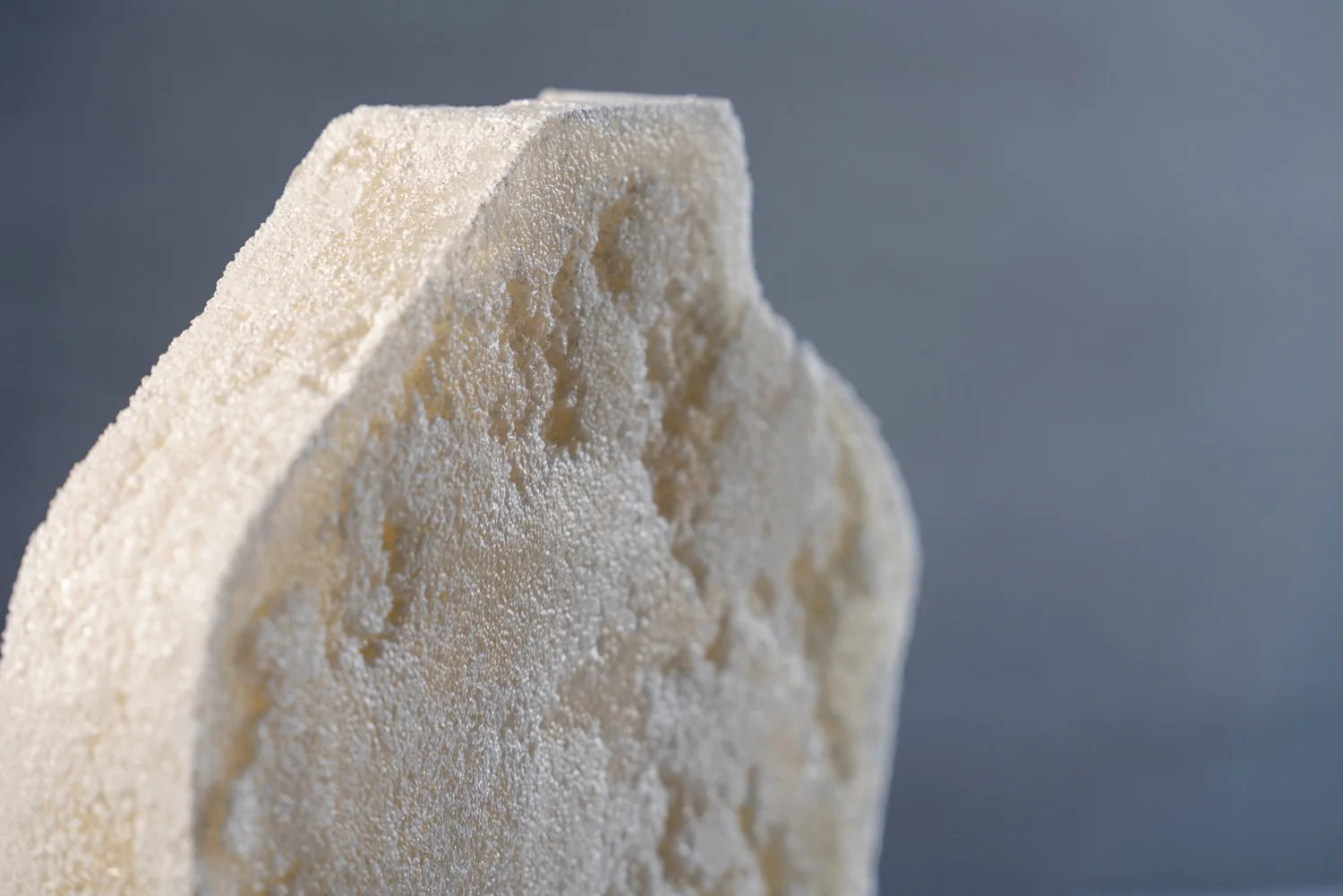
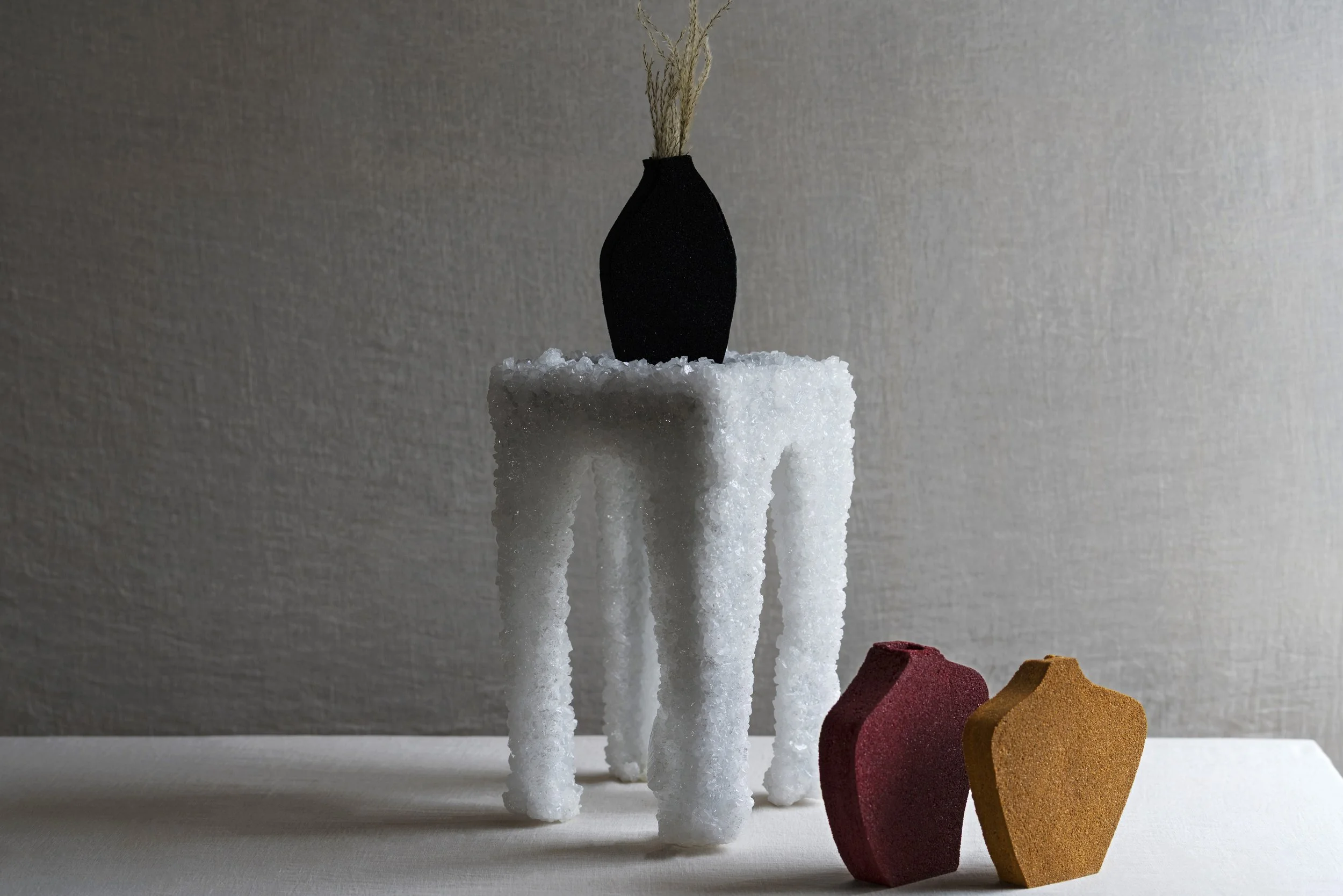
A product designer and graduate of the Royal College of Art, Julie Brière runs Studio Brière, where she explores the structural and aesthetic potential of unconventional material ingredients such as sea salt. Her work spans crystallization methods and composite development for furniture and homeware, earning her a place as a top exhibitor during London Design Festival, Material Matters, and London Craft Week.
When Julia first encountered Materiom AI, she saw an immediate application: help with formulations.
"When I saw Materiom AI, I immediately thought, oh, it can help me make formulas, because that's the hardest part."
What drew her in, though, was less the initial formulation and more the iterative back-and-forth. When an experiment failed — a binding agent didn’t hold, a composite crumbled — she would come back to the tool and describe what happened. The AI would suggest alternative additives, adjusted ratios, different fibres.
"When experiments weren't working, I would go back to it… I would tell it: that didn't work. Are there other compounds I could use, or other additives, fibres, for example."
For Julia, this feedback loop is what elevates the tool beyond a static recipe database. It compresses what might otherwise be days of solitary research into a quick, tailored dialogue.
Julia’s current focus is understanding how far salt composites can stretch — from bespoke handmade lighting to broader applications such as interior surfaces. Alongside that, she's investigating the long-term durability of her materials: how they behave over one, three, or five years, and what coatings might extend their lifespan.
"I also want to make sure that I can give accurate information in terms of how long it might last, or what coatings might be the best for the specific material.”
Adele Zavagno: AI as a starting point, not a shortcut
Adele Zavagno came to biomaterials through fashion design. Trained at Politecnico di Milano, she spent an exchange semester in Copenhagen experimenting with early biomaterial recipes, then entered the leather goods industry, where she has worked for three years. Feeling the pull back toward innovation, she enrolled in The Material Way, a year-long biomaterials course, before exhibiting at London Design week.
Adele had used Materiom's recipe library since university — recommended by her professors — but it was the arrival of Materiom AI that deepened her engagement with the platform. She found its responses noticeably more reliable than general-purpose chatbots.
"On your tool it feels like you're reading something accurate. I noticed sometimes that ChatGPT kind of invents things. I prefer to use this kind of tool for this purpose."
The difference, for Adele, comes down to data curation. Materiom AI draws on scientific literature and the platform's own vetted formulations rather than the open web. This ensures the majority of the system's responses are grounded in scientific fact and transparently traceable to good sources, which mitigates LLMs' tendency to hallucinate.
But Adele is clear about where she wants AI to stop. She doesn't want an algorithm generating creative solutions on her behalf — she wants a solid scientific foundation that she can interpret and recombine in her own way.
"I would like to make my own connections, and find my own solutions rather than have AI find them for me."
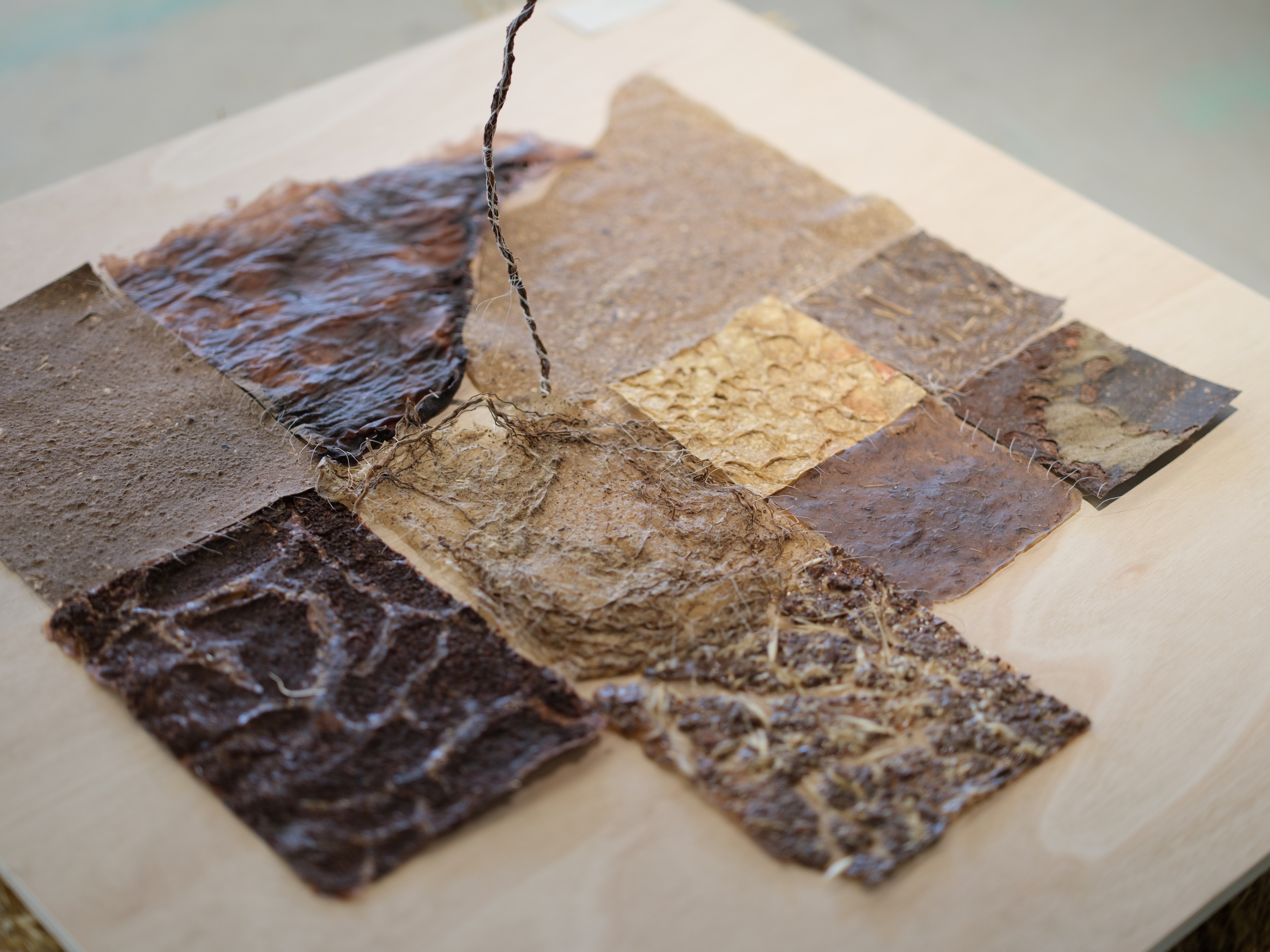
Her recent project is a case in point: sheets of starch-based bioplastic with seeds and fertilizer embedded between layers. Buried in soil, they dissolve, and within weeks the seeds germinate. The long-term product vision is a compostable shopping bag that, once discarded, grows into something living — a concept that draws directly on her understanding of both material behaviour and the demands of a consumer product.
"I think not all creatives need AI to be creative and send solutions to them. It's more interesting to elaborate on the scientific knowledge and do our part."
Muireann Nic an Bheatha: From open-access recipe to locally adapted formulation to functional product
Muireann Nic an Bheatha has been developing bioplastics for six years. After studying Art Science at The Hague in the Netherlands, she now works as a bio lab technician at a design school, where she guides students through every stage of biomaterial development — from sourcing local feedstocks to producing functional prototypes. Her lab is currently focused on bio-composites made from materials collected in the surrounding environment, such as seashells.
What surprised Muireann about Materiom AI was its ability to help structure her thinking, prompting her to define material specifications before entering the lab.
"When I bring up a project, I'm like, I want to make this bioplastic. And it's like, okay, do you need it to last for a long time, or biodegrade? How long? It’s so important to define those specs before you go and make the material."
The iterative process also has practical implications for the students she teaches. One student arrived at the lab having found a kappa carrageenan recipe on the Materiom Commons. She adapted the formulation to incorporate pine needles and pine cones sourced from the local landscape, adjusted the water ratio to suit her material, and produced translucent sheets that she wove into lighting fixtures and room partitions.
For Muireann, that trajectory — from an open-access recipe to a locally adapted formulation, to a functional product — is the kind of pathway that domain-specific AI tools can accelerate. General-purpose chatbots, she notes, often generate plausible-looking formulations that fail in the lab. A curated tool grounded in verified research could offer a more reliable starting point, particularly for newcomers.
"For me, the most important part is that it links research papers with hands-on making. There are many aspects of materials you will miss out on if you just write or read about them, such as how they feel, how the smell, how they act.
At the same time, just making materials without thinking or researching them means you miss out on the systems they are a part of, and how important these systems are (the origins of the biomaterials, and where they go if they become waste) to the materials themselves."
Muireann also sees the potential for a full feedback loop: practitioners could use Materiom AI to develop and refine their own formulations, then contribute those recipes back to the Commons for others to build on.
.jpg)
A feedback loop
These three experiences are connected by a simple insight: one of the most valuable things an AI tool can do for early-stage innovators is facilitate an evidenced two-way conversation that a) saves time and resources, and b) offers fresh perspectives.
For Julia, that means describing a failed binding agent and getting a reasoned alternative. For Adele, it means accessing trustworthy scientific literature that she can then reinterpret through a designer's lens. For Muireann, it means being prompted to articulate requirements she hadn't yet considered.
Learn more
To explore Materiom's open library of bio-based material recipes and try Materiom AI, visit the Materiom Commons.
Learn more about the practitioners featured in this article:
Voices is a series of conversations with innovators shaping the future of sustainable materials. We share stories of designers, scientists, producers and brand pioneers who have used Materiom’s tools and data as catalysts for their work. Each feature highlights how open knowledge empowers innovation — from early experiments to spinout labs, new ideas to impactful enterprises, breakthrough materials to real-world products.


